
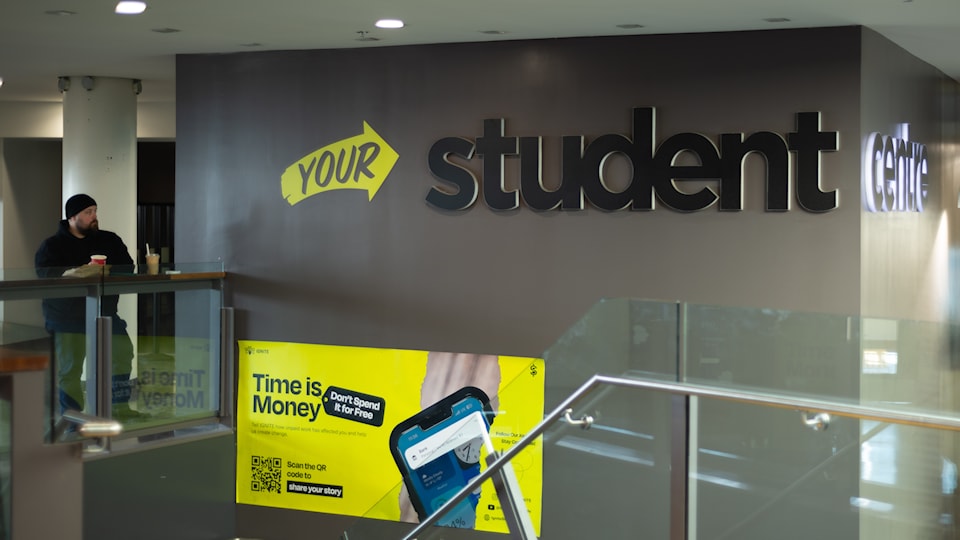
For many students, the student union is a mysterious mandatory fee on their tuition statement. For others, it is an organization that runs occasional events on campus. Rarely does advocacy come to mind.
That should be a problem.
A student union is an organized body within a university or college that exists to advocate for student rights and interests, while also serving as a hub for student activities and services. Advocacy is its fundamental role, not a secondary one.
At Humber Polytechnic and the University of Guelph-Humber, the student union is IGNITE. Yes, the one known for year-long campaigns, eye-catching graphics across campus, and handing out snack-sized Doritos or chocolate bars in exchange for Instagram follows, games, giveaways, or feedback forms.
It is loud and popular.
But when it comes to advocacy, it is nowhere near as loud.
Advocacy doesn’t mean the occasional bargaining update or a long-running petition campaign against unpaid internships. Every student union runs initiatives, services and campaigns.
Advocacy also means publicly addressing and sparking conversations around both short- and long-term issues facing students, including post-secondary funding cuts, OSAP approval delays, rising international tuition fees, the erosion of student services, and institutional decisions that directly affect student life.
On these issues, IGNITE has consistently remained reserved, if not completely quiet.
When the Lakeshore campus library closed last summer, there was no public statement, explanation, or call to action from IGNITE. After Humber Et Cetera published an editorial on the closure, a student reached out asking whether any advocacy was happening, whether there was a petition to sign, or a group that Et Cetera could connect them to.
That student had already contacted IGNITE well before the article was published, asking what it was doing. The student even offered to volunteer for advocacy efforts on IGNITE’s behalf.
IGNITE’s response was to suggest that students rely on stopgap measures by the college and contact the library directly by phone for further concerns.
“We want to reassure you that quiet study spaces will still be available in B Building, where the library was previously located. While these spaces will not include bookshelves or collections, they are designed to provide students with the same quiet environment that many relied on in the past,” said the IGNITE email provided by the student.
Does that mean IGNITE believes the closure was the right move? No information was provided on any advocacy or steps taken by the union. Ultimately, the student turned to Humber Et Cetera, which is independent of IGNITE, for information, while the union funded by student fees to advocate and inform offered no meaningful answers.
IGNITE student advocate Selena Ferreira said she hasn't heard much about the closure.
“I haven't heard anything about this particular issue in terms of direct communication with administration," Ferreira said. "I haven't heard about anything happening.”
She said the library closure was a side effect of post-secondary education cuts. However, Humber attributed the closure to low foot traffic and construction at the nearby B building.
Something similar happened when Humber issued layoff notices to Accessible Learning consultants. Students at the time told Et Cetera they did not understand what the changes would mean for them. It was after the issue gained momentum that IGNITE addressed the situation via social media.
More recently, the student space at Lakeshore was repurposed into a FIFA World Cup volunteer centre. In response to Et Cetera’s questions about advocacy efforts, IGNITE said it was not consulted by the administration before the decision, and it has raised concerns about the negative impact on student space.
“I believe it was mentioned at the monthly meetings,” Ferreira said. “From what I recall, it was like a work in progress to look into what can be done to provide a remedy or better communication to students about the closures.
“Because it was already agreed that G Building was going to be transferred into a hub for the FIFA World Cup, I don't think backtracking was possible,” she said.
As students, there is no way to verify if the student board discusses these issues.
IGNITE closed its board meetings to the public in 2019 and stopped publishing meeting minutes, citing student leaders’ desire to be more “candid” when discussing issues that “benefit students.”
“Sometimes that means being critical of external stakeholders,” Ercole Perrone, CEO of IGNITE, said. “It's not best practice for board meeting minutes to be publicized.”
IGNITE also does not post any of its behind-the-scenes advocacy efforts anywhere.
When advocacy is invisible, inconsistent, or unverifiable, skepticism is inevitable, especially when student leaders avoid speaking publicly on issues that directly affect students.
Even within IGNITE’s Time is Money campaign, the advocacy appears selective. While the union campaigns provincially against unpaid labour through petitions, students on campus report being unpaid or underpaid in co-op roles. Humber Athletics, for example, reportedly pays co-op students roughly half of Ontario’s minimum wage, about $9 an hour. Many students completing co-ops at Humber receive no pay at all. Meanwhile, IGNITE gives students a $20 Uber gift card for participating in photoshoots for its marketing material, which the student union can use indefinitely.
Does IGNITE’s board address unpaid labour at their home base before pointing to the province? Students do not know.
“There have been conversations [with Humber] about the general existence of the Time is Money campaign and promoting that and eventually what we're going to do with that,” Ferreira said. “IGNITE is aware that students are doing placements on campus that sometimes aren't paid, which is why we're trying to make this legislated.”
IGNITE may point to its provincial collaboration with the College Student Alliance as evidence of advocacy. The alliance represents four Ontario colleges: St. Lawrence, Fleming, Sault, and Humber. This should be a clear reflection for student leaders on how much influence, resources, and political leverage these unions have on issues.
Nevertheless, of all the issues put forward by the College Student Alliance at its annual summit — including post-secondary funding, international tuition fees, and affordability — IGNITE handpicked Bill 33 and its own Time is Money campaign to promote on its social channels, with no mention of the others. Bill 33 grants the provincial government greater control over student fees. It seems this is one of the most political positions IGNITE has taken in recent years, perhaps because it directly affects its own finances.
This is simply outsourcing of advocacy to factions like CSA while selectively amplifying safe topics that translate well into social media campaigns. Running a campaign is not enough. Advocacy must also happen at home, within the institution from which IGNITE collects student fees, and in ways that are visible and meaningful to the average student.
Student unions are a form of governance. They do not exist solely to distribute merchandise or host events. They exist to represent students, especially when that representation is uncomfortable.
If student unions choose to remain apolitical and risk-averse, they render themselves irrelevant. Student unions have political roots, and irrelevance is not what students are paying for.
.jpg;w=120;h=80;mode=crop)

